Showing posts with label flour. Show all posts

Wednesday, 6 August 2014

Lemon polenta cake

Polenta is one of the nicest grains for a cake, in that it provides a light yet firm crumb. Popular in Italian cuisine, polenta comes from corn.  


4 eggs, separated
250g caster sugar
80ml olive oil
120g polenta
200g plain flour/ground almonds
zest of two lemons

apricots, diced
icing sugar
juice of two lemons


Preheat the oven to 220C, and line the base of a cake tin with baking parchment.
Beat the egg whites until soft peaks are formed, then add the caster sugar whilst continuing to whisk.
Fold in the polenta, ground almonds and lemon zest.
Pour in the olive oil, whilst continuing to fold.
Put into the oven, and after 20 minutes turn the temperature down to 190C.
The cake should take around 40 minutes in total to cook, but depending on your oven, it is ready when the top is hard, and crumbs come out when a fork is put into the cake.
When the cake comes out of the oven, it is time to make the syrup topping.

In a small saucepan, heat the apricots until they start to soften. 
Add the lemon juice and the icing sugar, gently stirring to dissolve it.
When all the liquid has combined, pierce the top of the cake with a fork.
Drizzle the syrup over the cake - the pierced top means that the syrup is fully absorbed into the sponge.
Serve warm with soured cream.

Tuesday, 26 November 2013

Banana and salted caramel cake

Yes banana is healthy, but when combined with copious amounts of butter, sugar and cream, the benefits are most probably cancelled out...

100g soft brown sugar
50g soft brown sugar
150g unsalted butter
250g plain flour
one teaspoon of cinnamon
half a teaspoon of ground ginger (optional)
half a teaspoon of nutmeg (optional)
one and a half teaspoons of baking powder
two eggs, beaten
one vanilla pod
three bananas, mashed
50 ml milk
a dash of orange juice

equal weights of butter and soft brown sugar (I used 100g of each and still had enough to fill a jar size 190g)
coarse sea salt - to taste
double cream

Preheat the oven to 200C and line two 18-20cm cake tins.

Lined tins.

Cream together the butter and sugar.
Deseed the vanilla pod, and add to the butter and sugar.
Gradually beat in the eggs to the butter and sugar - if you do it too quickly, the mixture will curdle and separate.
Add half of the dry ingredients to the mixture and whisk.
Then add all of the milk and orange juice, and whisk.
Once thoroughly combined, add the rest of the dry ingredients.
Add the mashed bananas to the mix and stir together.
Pour into the tins and cook for 30 - 40 minutes.

Cake.

 
Salted caramel sauce.
 

Melt the sugar and butter in a sauce pan over a medium heat.
As soon as they have both fully melted, take off the heat.
Then add the salt and cream, and stir.
Leave aside to cool and thicken.
When lukewarm, drizzle onto the cake.

I topped the cake with extra pieces of cake.


For texture, you could add toasted walnuts to the mixture.
 

Tuesday, 29 October 2013

Pumpkin soup and seeded honey bread

Roasted pumpkin #1


Pumpkin soup


PUMPKIN SOUP
one large pumpkin
olive oil
juice of half an orange
boiled potato (if you want the soup to go further)
light brown sugar
nutmeg
pepper - to season
orange juice
salt - to season
soured cream, to serve

Preheat the oven to 200C.
Cut a pumpkin in half and deseed. Set aside the seeds for the bread
Deeply score the pumpkin.
Sprinkle the cinnamon and sugar over the pumpkin, then generously season with pepper and salt.
Drizzle the pumpkin with olive oil.
Bake in the oven until the pumpkin flesh is soft - this should take about 30-40 minutes.
Roasted pumpkin #2
Scoop out the pumpkin flesh, and blend with the orange juice, and potato if using. To thin the soup, you can add water, or preferably stock for extra flavour.
Serve with a dollop of soured cream.
Probably best to keep an eye on the soup when heating...
With a dollop (or two) or soured cream

For me, bread has always been one of those foods where the only quantities used are "a handful of this", "a dash of that", and "whatever looks right". Alternatively, start off with 50g flour per serving.

BREAD
white or wholemeal flour, for a heartier loaf use rye flour
a teaspoon of yeast / 7g sachet
seeds, you can use the pumpkin seeds from earlier, along with sunflower seeds and sesame seeds
honey
olive oil
warm water

Mix together the flour and the seeds.
Stir the yeast into an espresso-sized cup of warm water. It's important to add this to the mixture as soon as possible, because the yeast immediately reacts with the water, and is at its peak to work with the flour.
Pour the yeast water into the flour until you have a dough begins to come together.
Add oil to the dough-ish mixture until you have an only slightly sticky dough.
Flatten the mixture, and add the honey. I used about three teaspoons worth.
Fold the dough into an envelope shape, so all the honey is in the middle. Like a card if we're going to continue with the envelope metaphor.
Work the dough, and add more flour if it becomes to sticky.
Put in a lightly floured bowl, and cover with cling film.
Leave to rest in a warm place until the dough has doubled. This is usually about one hour.
Once the mixture has risen, work it... Knock the air out of the dough.
Then leave to rise again for an hour.
Preheat the oven to 220C.
Place the dough into a lightly oiled tin, or freeform on a baking tray.
Brush the dough with milk or beaten egg (for gloss) and sprinkle with salt.
Put in the oven.
After 20 minutes on 220C, turn the heat down to 180C. Cooking the bread for a short time on a high heat allows a crust to form, but if it is too high for too long the top of the bread will be burnt whilst the inside will be underbaked.
The bread should take about a further 40 minutes to cook. The bread is cooked if you hear a hollow sound when knocking the base.

Saturday, 19 October 2013

Mini Carrot Cakes

Everybody loves Raymond? Everybody loves carrot cake. These gems are light and dairy-free (discounting the topping) and healthy enough to be a gym snack. Well, not quite. But nearly.


Fresh from the oven
The cakes were lining two by two hurrah, hurrah
CARROT CAKE
one and a half medium-sized carrots, peeled and grated
caster sugar
rapeseed oil
olive oil
raisins (soaked overnight in whisky)
orange zest
orange juice
plain flour
baking powder
 
CREAM CHEESE ICING
cream cheese
unsalted butter, softened (optional)
icing sugar
orange zest


One half with filling, the other half not...
 

Mix together the oil, sugar, flour and baking powder.
Once fully combined, add the orange juice, zest and raisins.
Fold in the grated carrots.
Pour into a greased baking tins, and cook at 180C for 35 minutes, or until a skewer can be inserted cleanly.
When baked, leave to cool in their tins for 5-10 minutes, then turn onto a wire rack to cool completely.
When the cakes get to room temperature, cut them in half using a serrated knife.
 

Assembled
For the topping, if you're using butter, cream it with the sugar first, then add the orange zest and cream cheese.
If not using butter, gently fold the sugar and orange zest into the cream cheese.
 
Fill the cakes with the topping when they completely cool down - you don't want the icing to melt!
Serve with a cup of tea.


All together now...say cheese!


Thursday, 25 April 2013

Toasted walnut and gruyère biscotti

Toasted walnut and gruyère biscotti 
BISCOTTI150g plain flour
half a teaspoon of baking powder
pepper
dash of salt (because cheese provides a lot of saltiness)
2 small/medium eggs, beaten
70g whole walnuts
70g gruyère cheese, grated
a teaspoon of worcestershire sauce

Preheat the oven to 200C, and turn a pan onto medium heat.
In the pan, toast the walnuts for about 5 minutes, but be careful not to burn them! Constantly move them.
Mix together the flour, baking powder, salt, pepper and worcestershire sauce.
Then add the eggs, mixing with the fork until you get a good dough. You don't want the mixture to be wet, so add more flour if it needs it.
Roughly chop the walnuts into smaller chunks (discarding any burnt bits), and add to the dough.
Also add the cheese to the dough and combine by hand. Or do it all by food processor. But cooking like this is healthy! It's exercise! Cans of beans for weights, whisking egg whites for toning, and kneading for stamina. It's cheaper than a gym membership too!

Toasted walnut and gruyère biscotti
Divide the dough into two and shape into rolls.
Press down on the rolls so that you have fat, flat, long rolls (approx, and I mean approx 1.5cm x 5cm x 15cm)
Put them on a baking tray lined with baking paper, and 2 minutes before you put them in the oven, turn the oven down to 180C.
Leave to cook in the oven for 20-25 minutes.
When you take the biscotti out, cut it diagonally (it looks nice) with a serrated knife.
Put these slices back into the oven on the slightly lower temperature of 170C to cook for a further fifteen minutes. You want to dry the biscotti out a bit.

Serve with a nut dip, or a soup.
I would personally serve with a fresh chunky yet smooth blend of cashews and salted/honey roasted peanuts (blitz them together in a food processor) or guacamole, or French onion soup.


Peanut dip
You could:
add diced black olives/ serve with a tapenade
use sundried tomatoes instead of walnuts
use parmigiano reggiano
make a 'quattro formaggi' biscotti with 4 different cheeses

Monday, 22 April 2013

Pineapple Upside Down Cake

To be honest, there aren't many things you can do with an overripe pineapple. So I was thinking, why not do something using the excess sweetness and slight alcohol tint to complement something which is perfectly nice on its own, but could do with a bit of spicing up.
It's paramount to have fluffy egg whites, because juice from the pineapple drips into the cake (like a tarte tatin) making it a bit wet, and therefore making an otherwise light dessert, dense.
 
Pineapple Upside Down Cake
 
Serves 6

PINEAPPLE CAKE
1 small pineapple, cut into chunks
3 eggs separated
150g slightly salted butter, softened
150g caster sugar
150g plain flour (you can add baking powder for an extra lift)
a few spoonfuls of muscovado sugar
 
caster sugar to water in the units of 1:3 (respectively)
a teaspoon of chilli flakes

Pineapple Upside Down Cake
 
Preheat your oven to 200C and grease a cake tin.
Beat together the egg yolks and sugar until you get a smooth, creamy consistency.
Stir in the flour until you get a sort of wet crumble-looking mixture. Yes it should look like that.
Beat in the softened butter until you have a more typical cake mixture.
Then, whisk the egg whites until they're stiff like meringues.
When you add the egg whites to the rest of the mixture, don't add it from a height or you'll lose some of the air.
Stir the mixtures together until fully combined and you have a fluffy mixture. Yum.
Turn the oven down to 180C as you're nearly to put the cake in.
Put the pineapple in the cake tin, neat and evenly spaced, or dropped in (authentic).
Evenly sprinkle muscovado (or another dark brown sugar, maybe treacle) over the pineapple. This creates a kind of caramel, nuttifying the pineapple.
Completely cover the pineapple with cake mixture, and put in the oven for 40 minutes or until a fork comes out of the cake with a few crumbs. Check the cake at 35 minutes though.
When cooked, turn the cake out and leave to cool- if you leave it in the tin, it continues cooking, drying the cake out.
 
Over a medium heat, bring caster sugar and cold water to the boil in a saucepan.
Then turn the heat down, add the chilli flakes, and continuously stir until ALL of the sugar is dissolved.
Strain the syrup and leave to cool to remember.
The longer you boil the syrup, the thicker it will be.
Syrup keeps for one month in a sealed container.
 
Serve a slice of cake with a drizzle of chilli.

Pineapple Upside Down Cake
In the syrup I used chilli flakes instead of fresh chilli because I didn't want too strong a flavour.

Thursday, 14 February 2013

Pancakes

What is the difference between a pancake and a crêpe?
Crêpes are made from a thin batter and are light, whereas pancakes are thicker and fluffier. The size of a pancake is usually around half that of a crêpe.

What is the difference between an American pancake and an English pancake?
American pancakes having a raising agent like baking powder, and often use buttermilk instead of milk. Buttermilk can be made easily by squeezing some lemon into milk 10 minutes before you need to use it, and leaving it to curdle.

American pancakes
150g self-raising flour
a teaspoon of baking powder
125ml milk
one egg - I like to separate and whisk the white to give more lift.
olive oil or a few tablespoons of melted butter
a few teaspoons of demerera sugar depending on whether you're making sweet or savoury pancakes

Sift the dry ingredients together, and then whisk in with the rest of the ingredients.
On a medium heat, melt a blob of salted butter in a pan.
Pour in the liquid and don't touch until the pancake has solidified and begins to bubble. As American pancakes are small, you can make several in the pan at the same time. I tend to make mine between 7 and 14 cm diameter.
Flip the pancake and leave until golden.
Stack high and serve.

Notes/variations
Add blueberries or raspberries into the pancake mixture.
Serve the traditional way with crispy streaky bacon and maple syrup or golden syrup.
Fill with cheese, ham and spinach  and pine nuts, and roll to make a roulade.
Top with an egg or melted gruyere.

Crêpes
200ml milk - I find that full-fat holds a better texture
125g plain flour, sifted
2 eggs - and a bit of eggshell if you're like me!

salted butter

Blend all the ingredients together; this is best done adding the flour a little at a time.
Heat a crêpe pan (basically a normal pan with a thick base and low sides) until it starts steaming.
Turn the pan down to medium heat, and melt butter in the pan, swirling it around.
Pour in some of the mixture and leave until the edges curl and you can see steam. As long as you tilt the pan whilst pouring the mixture in, you will have a thin and evenly spread crêpe.
Flip the crêpe and leave until it turns golden.
As soon as it is ready, take off the heat, put in the filling and roll.

Notes/variations
I used salted butter as brings out the flavour of the crêpe.
Putting sugar in the butter before putting the crêpe mixture in it will give the crêpe a caramelised taste.
When all the crêpes have been made, you could roll them up, put them in a lined baking tray, cover with custard and bake until the custard sets- a bit like a bread and butter pudding.
Alternatively, you could make Cpes Suzette.


Wednesday, 9 January 2013

Tarte au citron Meyer

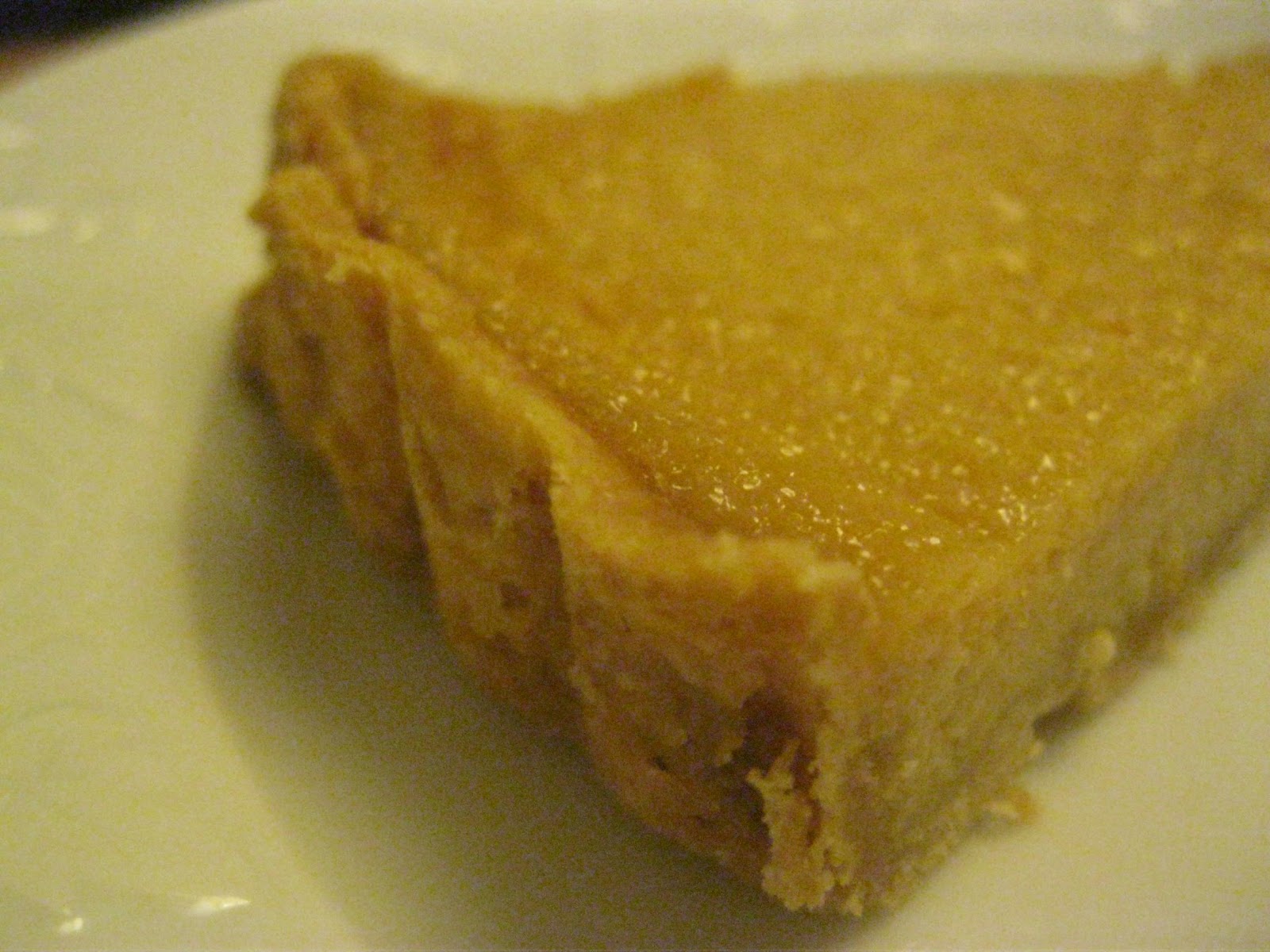
Tarte au citron is a classic French tart filled with a tangy lemon custard. I used Meyer lemons which are a cross between a lemon and a mandarin. They are quite sweet in comparison to other lemons, yet still quite tangy.


A nice even bake :-)


175g 00 flour (this flour is very fine, so makes the pastry more crumbly, it's fine to use normal plain flour though too)
140g unsalted butter, diced
30g soft brown sugar
25g icing sugar
zest of one lemon

5 eggs
160ml double cream
the zest and juice of 3 Meyer lemons
100g caster sugar

Sieve the sugar and flour, and mix with the zest of one lemon.
Add the cold butter and rub until you achieve a crumble mixture. As there is a lot of butter in this pastry, it shouldn't need any liquid. If you do add liquid, the consequence is that the pastry will not be as crumbly when cooked.
Wrap the pastry in clingfilm and leave in the fridge for 15 minutes to harden up.

Preheat the oven to 200C and butter a tart case.
Roll the pastry to less than a 1 centimetre thickness, and roll over the tart case.
prick the pastry case and blind bake it in the oven for 20 minutes. Instead of using baking beans, you can use baking paper with a similar sized cake tin on top.
Whilst the cake is cooking, whisk the eggs until they increase in size by about one and a half.
Add the sugar, lemon zest and lemon juice to the eggs, but continue whisking.
When thoroughly combined, pour in the double cream, and whisk again. You can add milk if you want a thinner mixture.
Pour into the tart case and bake for about half an hour, or until the filling is a little wobbly.

Serve cold with a spoonful of clotted cream.


You could
  • decorate with candied lemons
  • spread the base with lemon curd or melted dark chocolate, and cover with the filling mixture
  • use tangerines instead of lemons

Saturday, 29 December 2012

Spätzle

Spätzle dough

Spätzle is always fried in butter, but toasted breadcrumbs give an extra delicate crunch.


Freshly cooked spätzle
 
Spätzle is a good carbohydrate to mop up thick sauces with

Use approximately 100g of plain flour per person, and 1 egg for every 3 people as a general guidelines...

Add a dash of salt to your flour, and add the egg.
Mix with your hand of a spatula until you have a soft and slightly (but not too) wet dough. If you were using a food processor, use the dough hook.
Remember you can always add more flour or tepid water to get the perfect consistency.

Using a spätzle press, press the dough immediately into boiling water. When the spätzle has risen to the top, it is cooked... this usually takes half a minute to a minute. Immediately drain and pat dry.

With some seasoned melting salted butter in a pan, add breadcrumbs and toss the spätzle in it until it is crisped and golden.


What is spätzle?
Spätzle are a sort of pasta/noodle/dumpling originating from the Alsace region of Germany. Its often served topped with melted cheese