Showing posts with label sugar. Show all posts

Tuesday, 19 August 2014

Chocolate and cinammon cake

I was at loss at what to make for my granddad's birthday, after all you only turn 78 once! Having seen a stack of chocolate, lonely in the cupboard, I decided to put it to use. Originally I intended to make a large chocolate cake by itself, but I didn't think it would be enough, and so the cinnamon cake was born... If you were to close your eyes whilst eating the cinnamon cake, it would taste like a light cinnamon bun, but with crumbs. The cinnamon cake provides a contrast to the chocolate cake in that it has a less rich flavour. The espresso in the cake adds another dimension of bitterness so the cake is not overly sweet, whilst the salt brings out the flavour of the chocolate. The pepper adds a little bite to the sugary goodness. Whilst the white chocolate buttercream is sweet, the ganache is slightly bitter, and so the sugariness is not too much...Whilst they make the cake look quite dramatic, the nuts add another dimension to the cake in that they give more texture, more of a bite.


Cinnamon cake:
150g self-raising flour
100 caster sugar
50g brown sugar
two teaspoons of ground cinnamon
one teaspoon of bicarbonate of soda
150g unsalted butter, softened
a dash of milk
3 eggs

Preheat the oven to 180C.
Cream the butter and sugars.
Add the flour, bicarbonate of soda and cinnamon to the mixture, and fold in.
Whisk the eggs, then add to the mixture along with the milk.
Mix together until you have a smooth batter, and pour into a buttered baking tin.
Bake in the oven for 30 minutes, or until a few crumbs comes out of the cake when it is skewered with a fork.
Take out of the oven and leave to cool in the tin for five minutes, before turning out onto a wired rack.


Chocolate cake:
200g self-rasing flour
180g caster sugar
one teaspoon of bicarbonate of soda
150g unsalted butter, softened
a drizzle of olive oil
two teaspoons of coffee granules dissolved in 30ml of boiling water
two heaped teaspoons of cocoa powder
120g dark chocolate, melted
2 eggs
a teaspoon of sea salt
lots of freshly ground pepper

Preheat the oven to 180C.
Cream the butter and sugar.
Add the flour, bicarbonate of soda, salt, pepper. and cocoa powder to the mixture, and fold in.
Whisk the eggs, then stir into the mixture.
Once the espresso mixture has cooled down, add to the cake batter. If you add it whilst it is too hot, it will start to cook the eggs.
When the melted chocolate has cooled, fold into the mixture, along with the olive oil.
Bake in the oven for 45 minutes, or until a few crumbs comes out of the cake when it is skewered with a fork.
Take out of the oven and leave to cool in the tin for five minutes, before turning out onto a wired rack.


Dark chocolate ganache:
50ml whipping cream
80g dark chocolate, broken in pieces

In a small saucepan, heat the cream.
As soon as the cream starts to bubble, take off the heat.
Stir the chocolate into the cream, so it is fully combined.
Set aside to cool before using.


White chocolate buttercream:
150g unsalted butter, softened
180g icing sugar, sieved
150g white chocolate, melted
dash of milk

Cream together the butter and the sugar.
When you have a smooth mixture, pour in the white chocolate. Make sure the chocolate is not too hot, or the butter will melt, giving a runny icing.
If the icing is too thick, add a few drops of melt to thin it.


Toppings:
Chopped pistachios
Chopped caramelised hazelnuts


Assembling:
If the cakes are too high or too sunken in the middle, trim with a serrated knife, so that you have a flat surface. Make sure that the cakes are cool when you cut them, otherwise they will crumble, and will the trimming will not be as neat.
Spread your base cake with the chocolate ganache near to the edges. Don't spread right to the edges, or when you put the other cake not top, the filling will spill over the sides. I put the chocolate cake on the bottom because it was bigger.
Put the smaller cake on top of the ganache and press down firmly.
Using a palette knife, (preferably a straight one,) spread the buttercream over the top and sides of the cake. I find that working from the top down is easiest. The buttercream should be thick enough that it can hold the nuts, but not so thick that it is too much to eat in a slice...however much that may be!
Firmly press the hazelnuts onto the side of the cake so that they stick. Using a palette knife to press them in may help.
Spread the pistachios on the top of the cake, but much more sparsely than the hazelnuts were put onto the cake. 

Wednesday, 6 August 2014

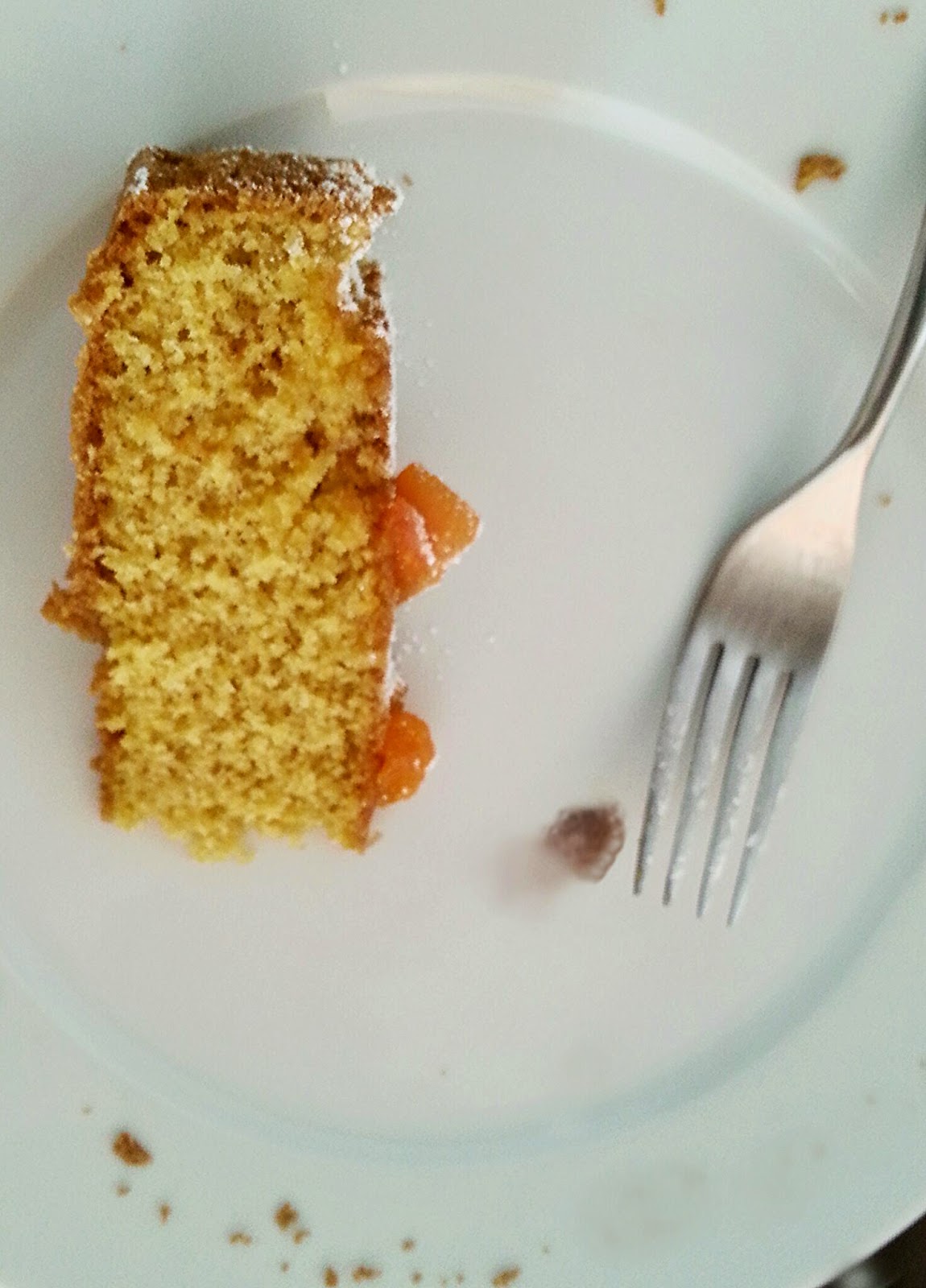
Lemon polenta cake

Polenta is one of the nicest grains for a cake, in that it provides a light yet firm crumb. Popular in Italian cuisine, polenta comes from corn.  


4 eggs, separated
250g caster sugar
80ml olive oil
120g polenta
200g plain flour/ground almonds
zest of two lemons

apricots, diced
icing sugar
juice of two lemons


Preheat the oven to 220C, and line the base of a cake tin with baking parchment.
Beat the egg whites until soft peaks are formed, then add the caster sugar whilst continuing to whisk.
Fold in the polenta, ground almonds and lemon zest.
Pour in the olive oil, whilst continuing to fold.
Put into the oven, and after 20 minutes turn the temperature down to 190C.
The cake should take around 40 minutes in total to cook, but depending on your oven, it is ready when the top is hard, and crumbs come out when a fork is put into the cake.
When the cake comes out of the oven, it is time to make the syrup topping.

In a small saucepan, heat the apricots until they start to soften. 
Add the lemon juice and the icing sugar, gently stirring to dissolve it.
When all the liquid has combined, pierce the top of the cake with a fork.
Drizzle the syrup over the cake - the pierced top means that the syrup is fully absorbed into the sponge.
Serve warm with soured cream.

Sunday, 1 December 2013

Chocolate and chestnut cake

This is quite a bitter cake, perfect for an after dinner treat. It has quite a moussey texture thanks to the folded egg whites

INGREDIENTS
400g whole cooked chestnuts
250g dark chocolate
150g unsalted butter
2 eggs, separated

100g dark chocolate
one orange - zest and juice
icing sugar, to taste
double cream, to taste


It's nearly Christmas already?!
CAKE
Pulse the chestnuts until you have a fine crumb.
Melt the chocolate over a ban marie, and add the butter.


Melted chocolate.
Once melted, leave the chocolate/butter mixture to cool.
Beat the egg yolks with the sugar and add to the chocolate/butter liquid.
Whisk the egg whites.
Combine the chestnuts with your chocolate mixture, and beat in two tablespoons of the egg whites.
Gently fold the mixture into the rest of the egg whites.


The mixture.
Pour into two lined cake tins and leave to bake for half an hour.
The finished product should have a crumb when a skewer is inserted.


ICING
Melt the chocolate and add orange zest as well as the juice of an orange. I used clementines as I didn't have any oranges, but their flavour was not intense enough to cut through the orange.
Add icing sugar to taste. The cake is bitter, as is dark chocolate, so you need some sweetness!
Add double cream to thin the mixture, and dilute the intensity of the bitterness.

Spread onto the cake.

Serve a slice of cake with crème fraîche.

Tuesday, 26 November 2013

Banana and salted caramel cake

Yes banana is healthy, but when combined with copious amounts of butter, sugar and cream, the benefits are most probably cancelled out...

100g soft brown sugar
50g soft brown sugar
150g unsalted butter
250g plain flour
one teaspoon of cinnamon
half a teaspoon of ground ginger (optional)
half a teaspoon of nutmeg (optional)
one and a half teaspoons of baking powder
two eggs, beaten
one vanilla pod
three bananas, mashed
50 ml milk
a dash of orange juice

equal weights of butter and soft brown sugar (I used 100g of each and still had enough to fill a jar size 190g)
coarse sea salt - to taste
double cream

Preheat the oven to 200C and line two 18-20cm cake tins.

Lined tins.

Cream together the butter and sugar.
Deseed the vanilla pod, and add to the butter and sugar.
Gradually beat in the eggs to the butter and sugar - if you do it too quickly, the mixture will curdle and separate.
Add half of the dry ingredients to the mixture and whisk.
Then add all of the milk and orange juice, and whisk.
Once thoroughly combined, add the rest of the dry ingredients.
Add the mashed bananas to the mix and stir together.
Pour into the tins and cook for 30 - 40 minutes.

Cake.

 
Salted caramel sauce.
 

Melt the sugar and butter in a sauce pan over a medium heat.
As soon as they have both fully melted, take off the heat.
Then add the salt and cream, and stir.
Leave aside to cool and thicken.
When lukewarm, drizzle onto the cake.

I topped the cake with extra pieces of cake.


For texture, you could add toasted walnuts to the mixture.
 

Tuesday, 12 November 2013

Caramel sauce


Some days you just need to indulge. Butter, sugar, butter, sugar, cream... probably not for the fainthearted! This ridiculously rich caramel sauce can be used for banoffee pie, to drizzle over ice cream, or to eat straight out of the jar. Don't tell anyone I said that.


To make 3 small jars:
150g unsalted butter
150g soft brown sugar
half a teaspoon sea salt
a dash of nutmeg
80ml double cream

DUNK!

Aside from the cream, chuck it all in a saucepan and leave on a medium heat to melt.
When the mixture it is about half melted, add the cream.
Stir the mixture every now and then, to make sure everything is melting.
Once you have a glossy mixture, take off the heat and leave to cool.
As it cools the mixture thickens, so place into sterilised jars once the mixture has cooled down a little.
Remember to seal jars, or a skin might form over the mixture.
This can be stored in the fridge for three days

Tuesday, 29 October 2013

Pumpkin bites

I'm going to be honest with you. Until recently, I wasn't sure what you could really do with pumpkins, aside from pumpkin soup, pumpkin pie, and the obligatory Halloween carved pumpkin. But I have been shown the light - no pun intended. There are over 15 different types of pumpkins, each with their own unique taste.
You have the sweeter varieties such as sugar pumpkins, small orange pumpkins best for puréeing and mashing, as well as the more salty/savoury ones, such as Japanese pumpkins which are dark green speckled with orange, and perfect for stir-frying.

When I made this recipe, I used the a small, orange "golden nugget" pumpkin, one of the most common types of pumpkin.

PUMPKIN BITES
one small pumpkin
coarse sea salt
nutmeg
cinnamon
olive oil
sugar (optional)

Preheat the oven to 240C.
Deseed the pumpkin and cut into slices with thickness of around 1 cm.
Line a baking tray with tinfoil and place the pupkin slices.
Sprinkle the pumpkins with the salt.
Sprinkle the pumpkins with freshly ground nutmeg and cinnamon.
Drizzle the oil over the pumpkin slices, and pop in the oven for around 25 minutes.
When the pumpkin is soft to the touch it is ready to come out.

These are perfect warm with a dollop of soured cream, or cold, when you get a chewy, toffee-like texture.
If you are using sugar, sprinkle demerara sugar on the pumpkins during the last 10 minutes of cooking.

Thursday, 17 October 2013

Apple bread and butter pudding

Bread and butter pudding
 
Let be honest, bread and butter pudding is a pretty great thing. It's warming, has custard and is ridiculously versatile - what's not to like? From substituting bread for croissants or brioche, flavouring the custard with coffee or chocolate and adding juicy liquor-soaked raisins, there's something for everyone. So for autumn, why not use up the glut of apples you bought for £1.50? This buttery, fruity recipe is meltingly delicious and perfect for those chilly autumn afternoons.

Buttered bread

APPLE BREAD AND BUTTER PUDDING
bread* - I used rosemary and potato bread
butter, room temperature
2 egg yolks
150 ml double cream
100ml milk - you're using double cream and butter, so you might as well have full-fat**
100g sugar
2 apples, cored, peeled and evenly sliced
cinnamon
nutmeg
a big handful of raisins
cognac
dried apple, diced
more double cream, to taste
*it's best to use bread which is a couple of days old because it holds it shape hence not becoming soggy. As the Berry says, you don't want a soggy bottom...
**it's important to build up fat to insulate for the winter

The first layer
Soak the raisins overnight in the cognac. Before using, pat the raisins dry to get rid of excess moisture, and set the rest of the cognac aside for later.
Spread the sliced bread generously with butter. Unless you're dairy intolerant, there are no reasons why you should compromise and use margarine.

Jam-packed full of raisins
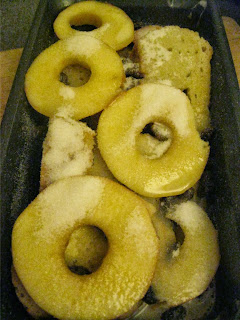
In a buttered and sugared tin**, layer the buttered bread with thickly sliced apples and raisins, similar to a dauphinoise. Repeat this until your baking tin is about three quarters full.
Beat the egg yolks with the sugar until your mixture has doubled in volume and become paler.

Heat the cream in a saucepan until it begins to bubble.
When the cream begins bubbling, take it off the heat and add the milk to it.
Once it has cooled down a bit, strain into the yolk/sugar mixture, whisking the whole time.◇◇

Sprinkling with sugar gives a brilliant toffee taste when cooked
When your baking tin is stuffed to the brim, liberally pour over with your custard.
Place in a preheated oven on 200C and bake for fifty-five minutes. When you take the pudding out, it should have puffed up and become golden and firm.
For the sauce, use the ratio of 1 part cognac to 2 parts cream.
In a medium-sized saucepan over a medium heat, reduce the cognac until you have a thick glaze.
Add dried the dried apple and double cream to your reduced alcohol and on a low heat, let it cook for half a minute, and take off the heat.

I would suggest that you don't put raisins on top, because they will catc,. And burn.

Sprinkle the pudding with caster sugar and scorch with a blowtorch or grill for a crème brûlée touch.

Serve with lashings of sauce and a generous scoop of vanilla ice cream.

**Butter the tin as you would normally, then sprinkle sugar over. Shake out excess sugar so you have a fine sprinkling on all sides. This helps to caramelise the pudding, and adds to the toffee-apple taste.
◇◇ If your custard becomes scrambled eggs die to the cream being too hot or not whisking enough, strain the mixture through a sieve.

YUM!

Tuesday, 6 August 2013

Gooey and indulgent chocolate cake

CHOCOLATE CAKE
250g dark chocolate (use milk chocolate for a fudgier taste)
250g unsalted butter
200g sugar - I used a mixture of soft brown sugar, caster sugar, and muscovado sugar
50g cocoa powder
4 eggs, separated

sea salt (optional)

Preheat the oven to 160C, and line a tray/tin with salted butter.
Melt the chocolate and butter in a bain marie, then set aside.
Beat the egg yolks, sugar and cocoa powder until thoroughly combined.
Add the mixture to the chocolate/butter mixture.
Whisk the egg whites until you get stiff peaks, then fold into the other mixture.
Pour into the tray/tin.
If you're adding the salt, sprinkle a little over the top.
Pop into the oven for 30 minutes - or until a fork comes out clean.
When cooked, leave in the tin for 5 minutes (to hold its shape), then turn out onto a wire rack to cool.
Serve with chantilly.

Monday, 21 January 2013

White chocolate macarons and a dark chocolate mousse filling (Macaron mess)


150g ground almonds (very fine)
225g icing sugar, sieved
100g white chocolate- probably about 80g once you've had a bit of it*
3 egg whites - keep the yolks for later
50g caster sugar
dash of salt

150g dark chocolate
20g salted butter
3 egg yolks
a whole egg separated

Mix the ground almonds and icing sugar until thoroughly combined.
In a separate bowl, whisk the egg whites to soft peaks. Add the salt and gradually add the caster sugar whilst whisking on a slow pace.
Fold the almonds and icing sugar into the meringue mixture, and then fold in the melted white chocolate.
Pipe the macarons  onto a baking sheet evenly spaced. If there are peaks on top of them, dab them with a damp finger.
Leave the macarons to rest for 40 minutes, until a skin forms on the top of the macarons.
In a preheated oven of 150C, bake the macarons, and make the mousse filling during the meantime.

Melt the dark chocolate and butter in a bain marie.
Once fully melted, beat the egg yolks into the chocolate and butter.
Whisk the egg white into stiff peaks and completely fold into the rest of the mousse mixture.
Pipe the chocolate mousse onto the cooled macaron halves.

However, if like mine you decided to use all your macaron mixture in one batch... break up the macarons and combine into the mousse getting a macaron mess (instead of Eton Mess - see what I did there?). It tastes the same even if the presentation is questionable.

Variations:
use coffee or dark rum in the mousse
make caramel macarons instead of white chocolate
make a lavender praline filling

*it might just be worth getting 200g on the off chance you eat more than a nibble. Just a thought...